The Case For Continental Coherence
The post–Second World War settlement represented an ambitious effort to stabilize great-power rivalry through layered institutions, open markets, and deterrence anchored by maritime dominance. That architecture, largely organized under the leadership of the United States and institutionalized through the United Nations, NATO, and the European Union, assumed that sovereign nation-states could responsibly manage existential technologies within a shared liberal order. The framework succeeded in preventing direct great-power war, yet it did not complete the deeper political consolidation imagined in wartime planning. Instead, a global market layered atop fragmented sovereignty has endured, with tensions between scale of capability and scale of governance. Therefore, in an age of compressed global power, the future of human civilization must account for these errors and engineer a better solution.
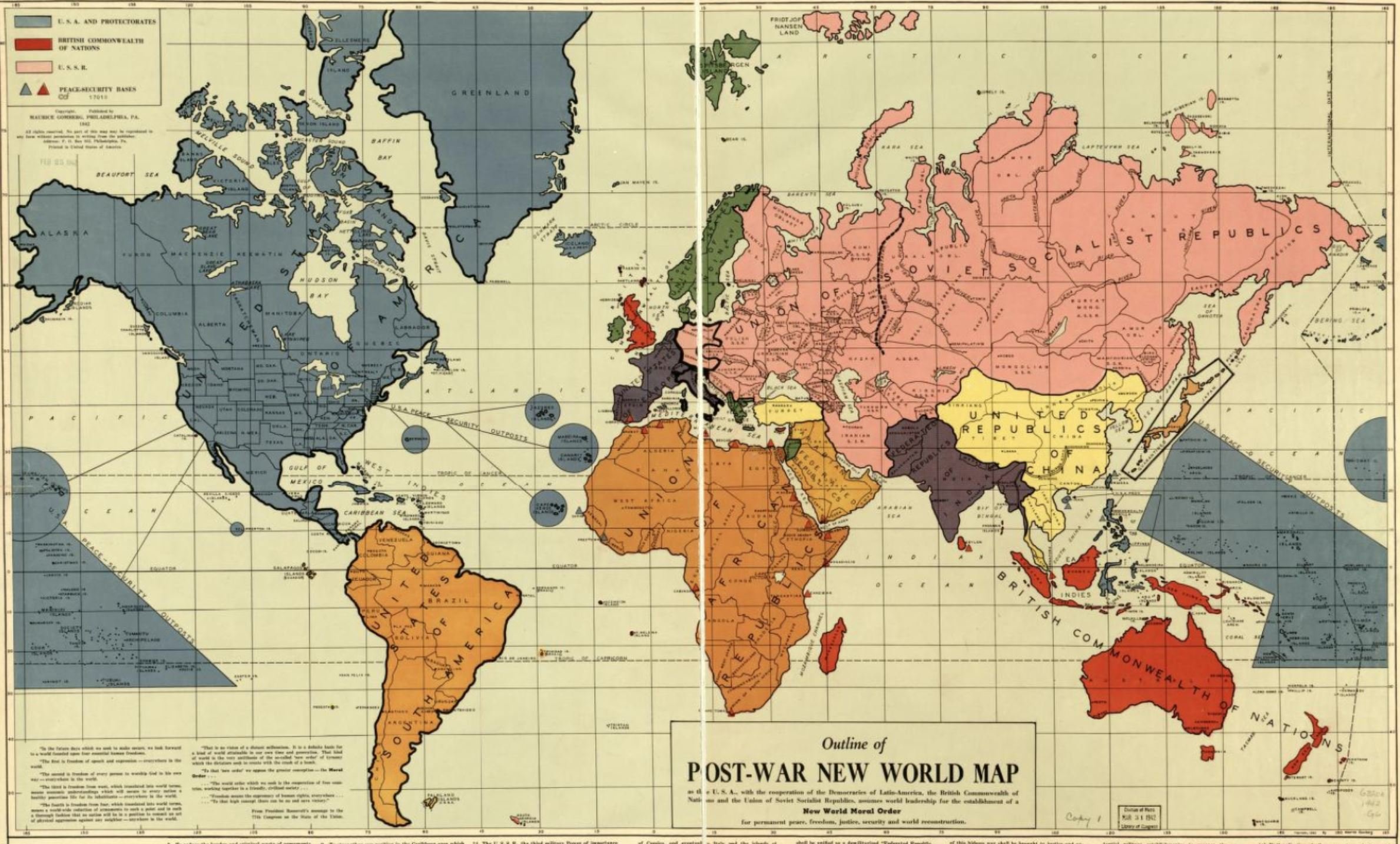
Desired Outcome, Post WWII
Today’s strategic environment renders that argument more urgent and more conditional. Nuclear deterrence once defined the upper boundary of catastrophic risk. Now artificial intelligence, autonomous systems, cyber-physical infrastructure, space assets, and synthetic biology compress decision cycles and expand failure radii. The capacity to disrupt at scale increasingly exceeds the absorptive capacity of individual states. As in aviation or nuclear safety engineering, high-risk systems require governance structures commensurate with their destructive potential (Perrow, 1984). When “decision velocity” or “intelligence capability” accelerates while political legitimacy remains nationally bounded, the probability of miscalculation grows. The ongoing question is whether regional bloc formation stabilizes or destabilizes the transition from a unipolar to a multipolar order.
I have argued it can be a self-stabilizing system. See my presentation here.
Grand strategy has historically advanced through architectural innovation rather than rhetorical alignment. The Concert of Europe did not eliminate rivalry among the great powers; it altered the geometry through which rivalry was managed. Bismarck’s alliance system did not depend on permanent harmony; it constructed overlapping commitments that narrowed escalation pathways. The post‑1945 order similarly did not arise from shared sentiment alone; it embedded American power within institutions such as NATO and Bretton Woods, which reshaped incentives and constrained miscalculation. In each case, the decisive variable was not purely motive based (why), the variables focused on execution of structure (what). Actors retained agency and their range of action was filtered through newly constructed institutional layers. In a technologically compressed multipolar system, where operational architectures increasingly mirror one another, and speed dilutes motivation, strategic differentiation… again… rests less on declared intent… what matters more is design of the system within which intent operates. Institutional construction, therefore, becomes the primary mechanism for altering trajectory.
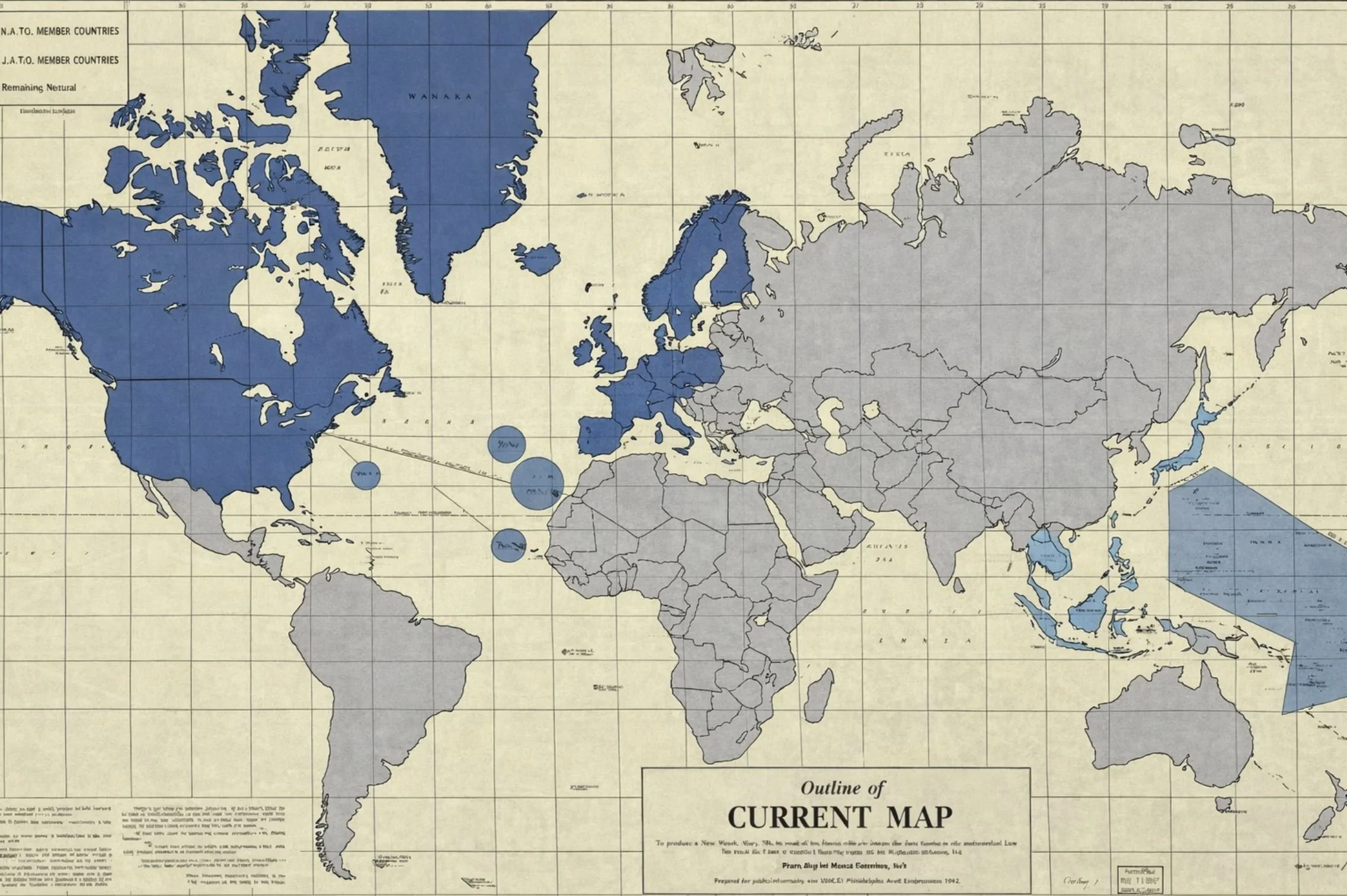
The Reality, Post WWII
Strategic competition between China, the United States, Russia, and Europe illustrates grand strategy. China’s approach blends reactive containment balancing, long-horizon civilizational positioning, and incremental assertion. Western commentary often projects the experience of other regional conflicts onto adversaries, equating distinct historical cases without accounting for structural differences. Russia is increasingly territorial and turning inward to manage constraints after a prolonged period of outward power projection, while Europe is doing the same through different means. Such analogies obscure the distinction between short-horizon revisionism, and layered repositioning alongside structural requirements. China’s strategic culture reflects patience, economic leverage, and ambiguity, yet patience does not preclude ambition. While other mentioned powers are often more spontaneous. Ultimately, the removal of material constraints—particularly technological or energy dependence—can widen an ambition envelope without altering rhetoric. Therefore, constraint removal paired with hardened narrative framing would mark a significant inflection point. Such a point must be avoided.
Re: Taiwan
Taiwan remains central to this calculus, as do proxies and their interests. If China meaningfully reduces reliance on Taiwanese semiconductor production, incentives shift in two directions. Economic restraint diminishes, yet the practical need to seize physical assets declines too. Identity narratives and legitimacy politics then carry different weight. A durable equilibrium requires the absence of imposed timelines and the presence of credible off-ramps. History demonstrates that crises often arise when actors perceive closing windows of opportunity (Allison, 2017). The interaction between perceived window compression and domestic legitimacy pressure warrants sustained attention.
Re: The Arctic
The Arctic offers a revealing barometer of strategic posture. The region is emerging as a corridor for shipping, resource extraction, submarine transit, and data infrastructure. Small, incremental moves—expanded fishing fleets, scientific expeditions, port investments on foreign territory, under-ice submarine exercises—accumulate meaning over time. These activities do not predict where a shock might occur; they illuminate whether a state’s ambition envelope is expanding beyond regional containment. Sustained dual-use logistics and normalized military access would signal a shift from episodic signaling to durable global reach. In this sense, Arctic behavior reflects posture rather than theater.
Re: The Middle East
The Middle East presents a different variable. The region remains critical to global energy flows and financial capital buffering. Diplomatic normalization efforts suggest an evolving equilibrium, yet energy pressures, maritime route, and shifting capital ramps create vulnerability. Should supply constraints intensify, external powers may deepen their security-of-supply posture. Managed entanglement differs from quagmire. A quagmire arises when an external power assumes responsibility for internal political order rather than limited asset protection. Historical precedent cautions that open-ended stabilization commitments erode strategic focus (Westad, 2005). The likelihood of escalation increases if actors perceive that access to critical resources is narrowing.
Re: Endurance Doctrine
Endurance doctrine forms another layer of analysis, not only in China, but Russia, Europe, and the United States. Demographic contraction incentivizes automation, robotics, and logistical resilience. Military and commercial applications are sprawling and growing to compensate. However, capability symmetry alone does not predict use; doctrine and political incentives do. Modern conflict rewards sustained logistics, redundancy, and information dominance over raw manpower. A strategy centered on protracted national endurance emphasizes stockpiling, financial insulation, and infrastructural redundancy; these are signals to focus on in the future. Observers should monitor adjustments in these domains rather than just production scale.
Shock, in foreign affairs, always emerges from interaction effects. Three conditions together elevate risk: widening ambition envelopes, rising escalation sensitivity, and removal of material constraints. Escalation sensitivity includes threshold interpretations shaped by domestic politics and media amplification. A peripheral action can be read as a red-line crossing if, and often if, narrative environments are primed. Spiral dynamics operate independently of formal calendars. The stability of the current system therefore rests on calibrated signaling and credible de-escalation mechanisms (chaotic mechanisms grow in abundance in a system where executive policies and war powers are not elevated above middle-ground political systems like the United Nations.).
Re: The Intended New System
Another way of stating this is to examine how escalations can be handled. Through small rooms of executive-branch leadership, or through broad, public, and bureaucratic channels. The first is where most de-escalations triumph historically (Washington Hotline), and the seond is where failure is often found. So tightening and formalizing a top layer of alignment, in an increasingly polarized world, with more than 200 countries, seems like a logical next-step. Influence-operations in democratic systems add too much complexity during an escalation. Open political environments, such as the United Nations, invite too much external engagement through economic and informational channels, and these are where most bottlenecks of political throughput occur. Effective governance of escalations distinguishes between lawful participation and malign interference, while maintaining domestic cohesion; in today's system, that governance is almost nonexistent. Overstated narratives risk amplifying internal polarization, which in turn heightens escalation sensitivity.
A continental architecture, thereby where global powers are framed as formal and clear institutions, can be immediate risk containment responding to the dynamics described above. Hard power anchored at the continental scale aligns military responsibility with geographic sphere, and leadership is aligned to AI communication channels at the bloc level. Such blocs elevate survival-scale force and technological oversight while preserving national governance and civil society. International institutions (The United Nations) would still retain authority over arbitration and cross-regional norms, such as regional issues and commerce; sovereign governments would maintain domestic legitimacy; families and communities would anchor meaning. This layered separation of force, law, commerce, arbitration, and identity with communication and leadership… defines a new scale, and each layer reduces the likelihood of coercive power.
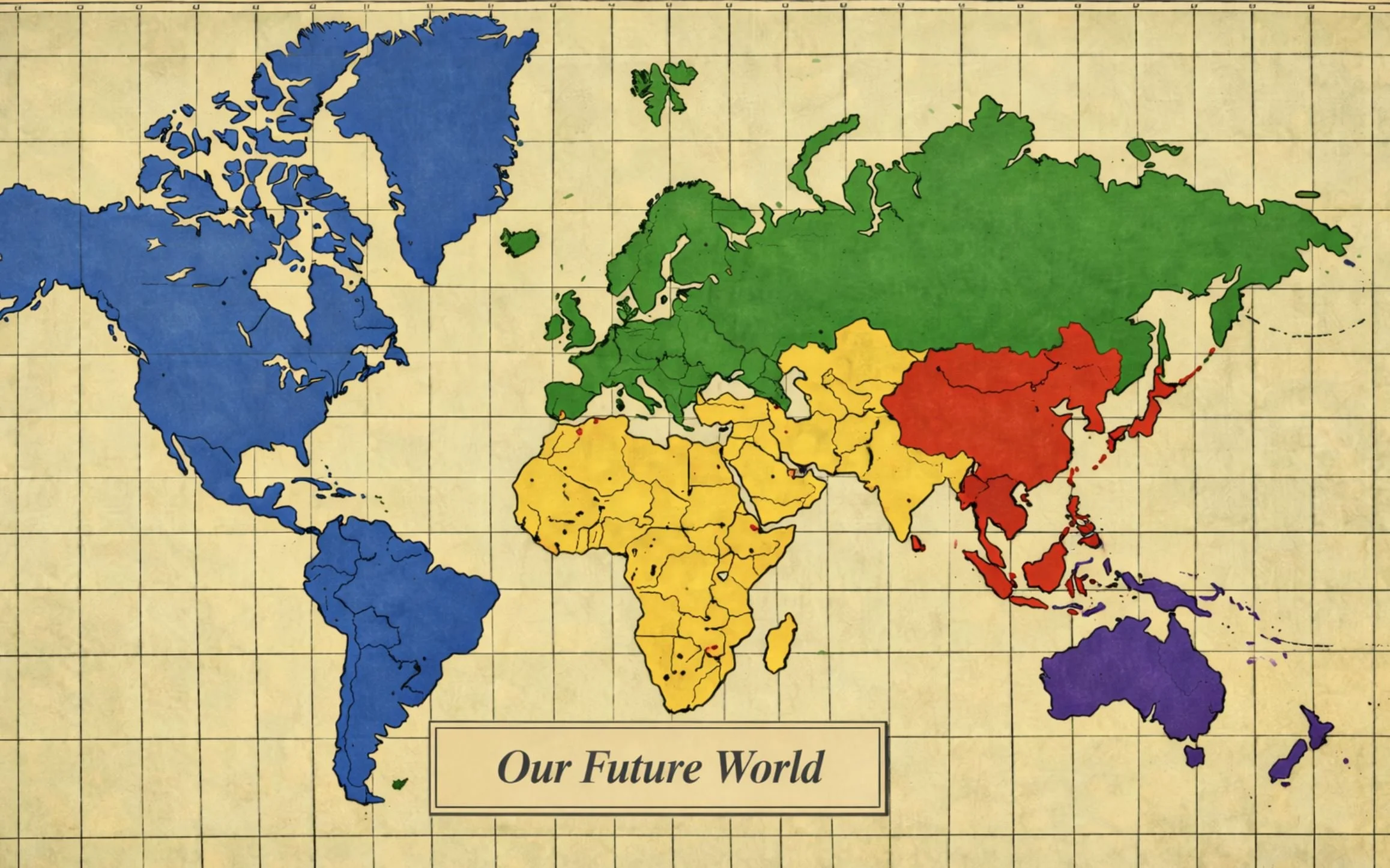
The Approaching Future
Re: New Finance System
Financial architecture also shapes stability. Earlier monetary systems linked value to scarce, enforceable substrates. As terrestrial resource politics intensify, proposals for asset externalization reflect a search for conflict-resistant anchors. This is most evident with the emergence of crypto as a primary effort, and space-based hosting of AI systems as secondary, and new space-based legal frameworks as tertiary effects. Whether such systems mature remains uncertain, yet the impulse to decouple financial claims from contested geography and centralized arbiters, such as banks and transaction handlers (which have sovereign leanings) indicates a recognition that debt-fueled leverage exacerbates rivalry (Eichengreen, 2019). This is overall a positive for continental ordering. Monetary evolution interacts with security architecture; both respond to scale mismatches.
Re: Dependencies and Considerations
The path forward is conditional. Smooth transition toward continental coherence is plausible, if, actors refrain from imposed timelines, maintain open channels for de-escalation, and resist narratives that frame competition as existential zero-sum struggle. Abrupt transition follows if ambition expands faster than alignment capacity. The aim should prediction and instead focus on preparedness. High-risk systems demand redundancy, transparency, and procedural safeguards; these must be core objectives. As destructive capabilities scale, governance must also scale accordingly.
Strategic history, counsels wisdom. Great-power transitions rarely unfold without tension (Kennedy, 1987). Yet institutional adaptation has repeatedly averted catastrophe, so adding another top layer of institutional management seems like a rational and required course of action. Surely such a system can’t stand on policies alone. Continental coherence, understood as alignment between geographic and political layers, responsibility and strategic authority, offers one avenue for stabilizing an era of compressed power via technology. The objective is longer strides of stability within a plural world.
The alternative avenue is a increasingly pertuse one-world-order driven by coercive power, which is not ideal.
Re: Considering Possible Timelines & Themes
Projecting forward requires clarity regarding timelines, constraints, and probabilities. In the near-term window of 2025–2030, the probability of a large-scale kinetic shock among major powers appears moderate, but not dominant, approximately 25–35 percent, primarily driven by interaction effects rather than deliberate strategic design. Constraint removal in technology and energy sectors will likely accelerate during this period; a re-design of constraint will focus on a distributed approach, and thus ambition envelopes are expected to widen gradually rather than abruptly. The most plausible disruptions in this timeframe remain peripheral and signaling-based: maritime friction, cyber escalation, sanctions cycles, population health (cognitive declines) and proxy recalibration. Technological standards development could also be a trigger, if pushed too abruptly.
Between 2030–2040, structural pressures will intensify as adjustments to demographic shifts and population health becomes focused. Artificial intelligence integration into command, logistics, health and financial systems will also become commonplace, either lowering or raising escalation sensitivity, even if intentions remain bounded. During this decade, the probability of either informal continental consolidation or a destabilizing spiral, increases materially. If ambition expansion outpaces governance innovation, and institutional creation, then shock probability may rise toward 60–70 percent broadly. Conversely, if bloc-level coordination mechanisms mature into formal structures — particularly in hemisphereic realignment, arctic posture management, AGI timeline ambiguity, and Middle Eastern energy stabilization — the system may trend toward a more productive horizon.
Beyond 2040, probabilities diverge sharply based on institutional adaptation and population health dynamics. Should continental coordination layers formalize without eroding sovereignty, the likelihood of systemic stabilization increases substantially, potentially reducing shock risk below current baselines despite higher technological capability. If governance remains nationally fragmented while destructive capacity scales (specifically militarized AI and robotics), instability compounds. In that scenario, escalation becomes less a matter of intent and more a loop-function.
Key constraints shape these projections. “Social” contractions in the populations of major powers incentivize automation and endurance doctrine rather than expansionary occupation. Energy diversification reduces single-point leverage, while increasing infrastructure vulnerability. Financial decentralization, including early-stage crypto architectures, signals dissatisfaction with centralized arbitration, but has yet to produce a durable alternative substrate. Domestic political polarization across multiple democracies increases escalation sensitivity, though it also constrains overt aggression.
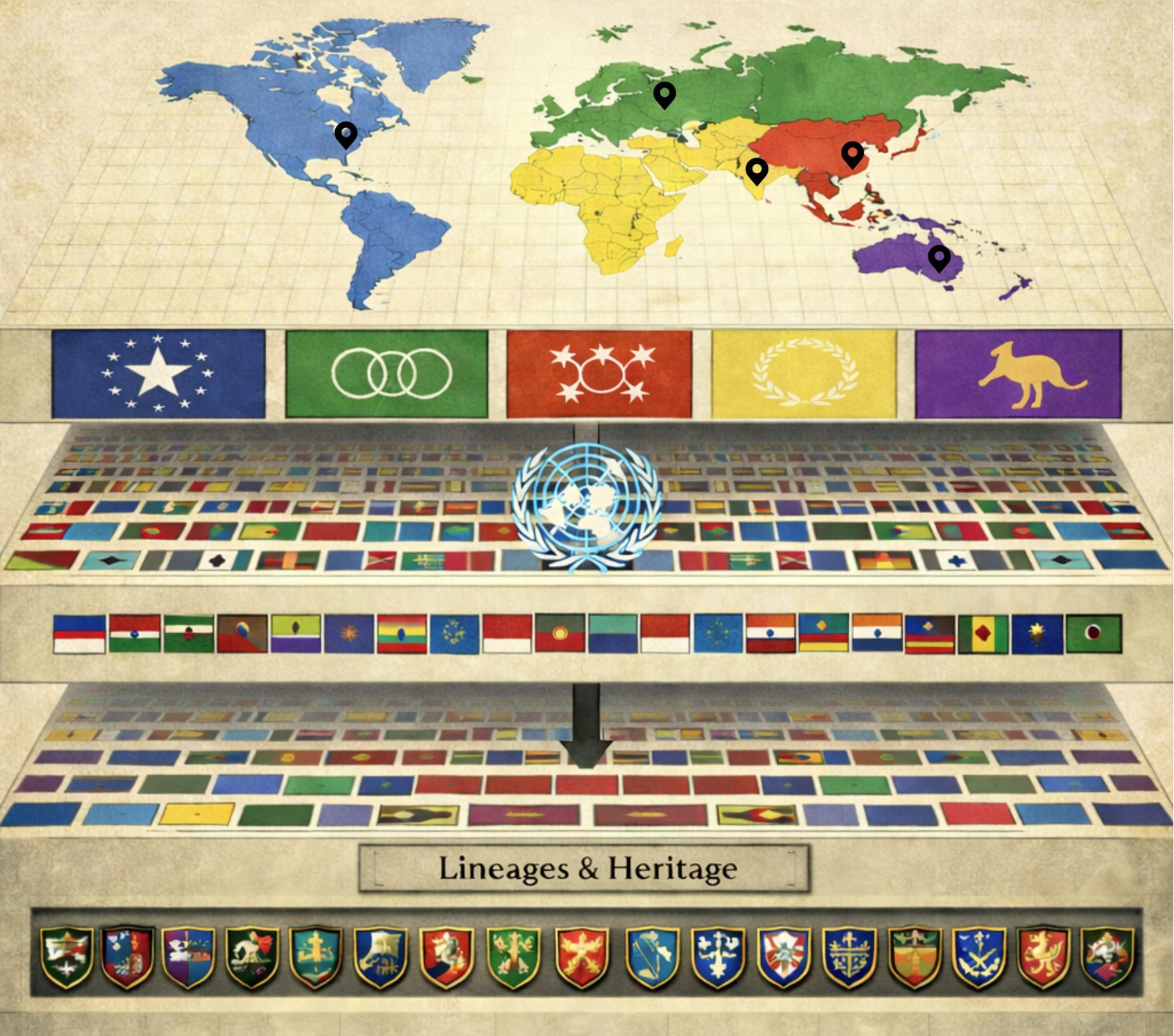
New Institutional Top Layer
Taken together, the most probable trajectory remains incremental continental consolidation under competitive conditions rather than abrupt and ambiguous systemic rupture. Shock remains possible, particularly if constraint removal coincides with hardened rhetoric and narrowing perceived windows of opportunity. Therefore, constraint design should be prioritized. The prevailing tendency should be toward clear competition, within widening, but bounded, ambition envelopes. A good system shows characteristics of adaptive pressure rather than imminent collapse.
References
Allison, G. (2017). Destined for war: Can America and China escape Thucydides’s trap? Houghton Mifflin Harcourt.
Eichengreen, B. (2019). Globalizing capital: A history of the international monetary system (3rd ed.). Princeton University Press.
Kennedy, P. (1987). The rise and fall of the great powers. Random House.
Perrow, C. (1984). Normal accidents: Living with high-risk technologies. Basic Books.
Westad, O. A. (2005). The global Cold War. Cambridge University Press.