Data Centers on Mars
In early October, I grabbed a beer with peers at work and ranted for a few hours: the topic of choice was “why don’t we build data centers on Mars?” If Elon can launch a Tesla car into orbit, how hard could it be to shoot somthing that lands itself on a dusty red planet? Or at least launch somthing into orbit, so that we can have edge-compute closer to orbital network sources.
To my surprise, my peers edged-me-on.
They suggested I email the CEO of X, Astro Teller.
At first, I thought, “no no no, that could get me fired.”
Well, then I did it. The most absurd email of my career.
To my suprise, Astro’s executive assistant forwarded the email and he responded, but I can’t share it. The response was polite and measured :)

In the 1960s, Apollo spacecraft carried guidance systems that were effectively mini data centers for their time. They weren’t branded that way, but they performed mission-critical computation off Earth. They were compute modules in space. We’ve done this before. And many people once talked about dumping “trash” onto other planets. So if the ethics of “dumping waste” are “ok”, why not computational pods?
Space changes the constraints placed upon current data center technologies. Solar energy beyond Earth’s atmosphere is abundant and nearly continuous. Vacuum conditions alter thermal assumptions, enabling radiative cooling architectures that are impossible within dense atmosphere. Physical security becomes nearly absolute. Jurisdiction becomes ambiguous. Most importantly, deployment complexity collapses if the payload is self-contained. Modern space missions are difficult primarily because of crew requirements and intricate cargo deployment systems. Remove humans. Remove surface construction. Deliver a sealed compute unit designed to operate autonomously. The mission simplifies.
The Mars framing was partly symbolic, because this year Elon talked exstensivly about Mars. A SpaceX + Google partnership would be cool, and strategic. As satellite constellations mature and laser interconnects improve, deep-space communication latency becomes a solvable engineering variable rather than an existential barrier. An off-planet node introduces a new category of redundancy. Imagine cold storage of critical datasets, like financial ledgers, root DNS data, archival knowledge, etc… all positioned beyond terrestrial catastrophe scenarios. Not as a production region competing with Northern Virginia, but as a civilizational vault. A sovereign backup layer for digital memory.
There is precedent for power generation beyond Earth too. The United States launched the SNAP-10A nuclear reactor into orbit in 1965. It functioned. The engineering challenge is not mystical. Radiation hardening, redundancy, and failover are already standard concerns in aerospace systems. The core technological pieces exist, and they just need to be assembled around the concept of hyperscale compute.
I think the real barrier is psychological. People need inspiration.
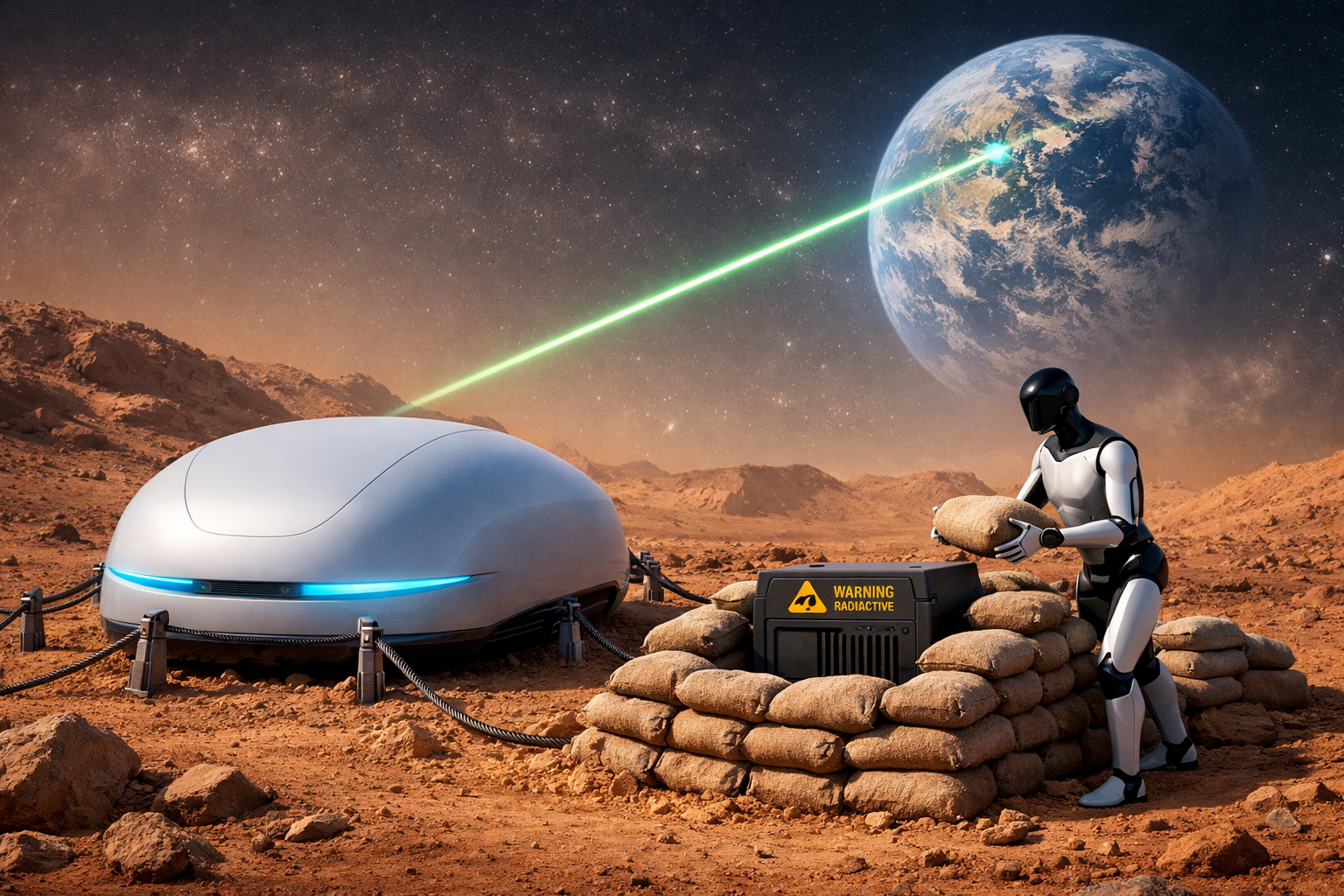
Data Center on Mars Concept
Anchoring all advanced computation to a single planetary surface may eventually look risky.
Perhaps the idea will remain a thought experiment. But infrastructure decisions compound across decades. The architectural assumptions we cement about data centers, in this decade, will shape the energy map and resilience posture of the next 50 to 100+ years.
…Maybe someone will tackle this challenge in the future.
…Maybe someday I can join them.