Abstract
The world has spent decades installing digital infrastructure into almost every environment we inhabit. Computers, phones, servers, cameras, vehicles, industrial systems, and network equipment collectively form an enormous hardware surface. Each device contributes some combination of processing power, working memory, and persistent storage. Before asking what future AI infrastructure might look like, there is a simpler question: how much capacity have we already built?
Our preliminary global inventory places persistent digital storage at approximately 13.2 zettabytes in 2026. It estimates working memory at approximately 0.13 zettabytes and conventional FP32 processing capacity at approximately 10 zettaFLOP/s. A separate estimate places dense AI matrix processing at approximately 40 zettaFLOP/s. These are installed-resources across the digital ecosystem, including capacity already occupied by existing workloads.
The two compute figures describe different arithmetic capabilities and are not additive.
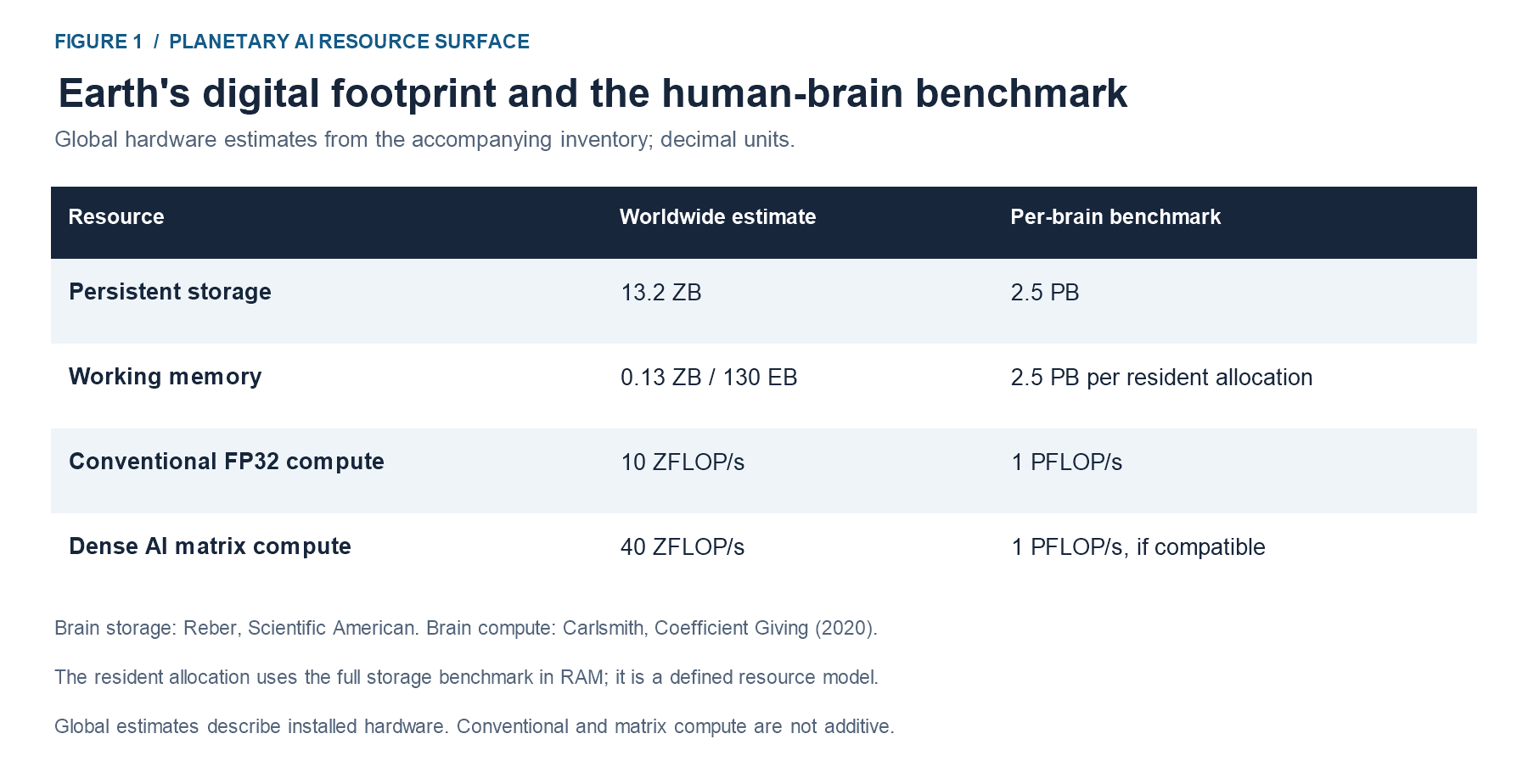
These numbers become easier to understand when placed against a familiar biological reference. Paul Reber's discussion in Scientific American estimates the human brain's storage capacity at roughly 2.5 petabytes. Dividing the worldwide storage estimate by that benchmark gives 5,280,000 human brains' worth of storage. The opening observation is therefore straightforward: the digital environment already contains a storage footprint comparable in size to the estimated memory capacity of more than five million human brains.
The storage estimate comes from interpolating IDC figures reproduced in Huawei's 2025 Global Digitalization and Intelligence Index: 10.2 zettabytes in 2024 and 19.3 zettabytes in 2029. The working-memory and compute totals come from our preliminary reconstruction of device populations and installed hardware configurations.
Creating a visual benchmark
Storage is only one part of the comparison.
To ask how much digital brainpower exists, we also need a computational benchmark. Joseph Carlsmith's report, “How Much Computational Power Does It Take to Match the Human Brain?” examines the problem through four approaches: modeling biological mechanisms, reproducing known brain functions, examining physical limits, and considering communication within the brain. His overall assessment is that one petaflop per second is more likely than not sufficient to perform tasks as well as the human brain, given the right software. We use that figure as the computational benchmark for this exercise.
The resulting reference brain has two specified resource quantities: 2.5 petabytes of information capacity and one petaflop per second of computation. These benchmarks let us compare Earth's digital resources with the brain in consistent numerical terms. The storage benchmark describes information capacity; the compute benchmark describes a proposed budget for matching task performance. Their combination is a resource model, rather than a measurement of intelligence already running on the hardware.
How many brains can the digital footprint hold?
Against these benchmarks, our global storage estimate equals 5.28 million brain-sized information capacities. The working-memory estimate equals 52,000 such capacities held in RAM and accelerator memory. The conventional FP32 compute estimate equals 10 million brain-equivalent computational budgets. The separate AI matrix estimate gives a numerical ratio of 40 million budgets, assuming that arithmetic suits the implementation. The conventional compute figure provides the principal comparison; the matrix figure shows the additional scale associated with specialized AI arithmetic.
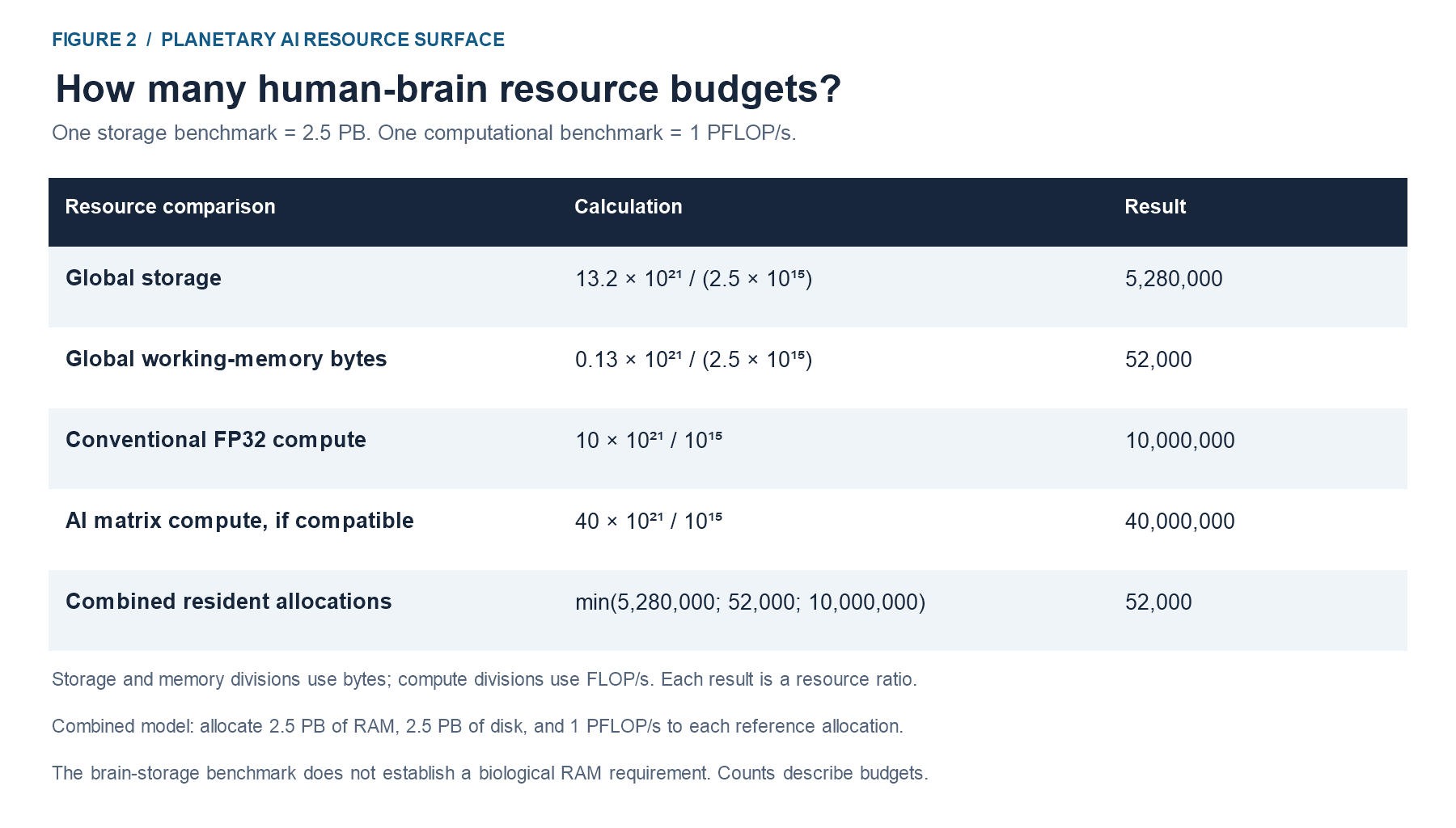
This reveals an interesting structure. Earth's digital ecosystem has millions of brain-sized storage capacities and millions of brain-equivalent processing budgets, but a smaller amount of fast working memory. If we want a single combined count, we must specify what each digital brain-sized allocation needs. For an allocation containing the full 2.5 petabytes in working memory alongside one petaflop per second of processing, the combined count is set by the smaller resource pool: approximately 52,000 allocations. This is a deliberately memory-resident model; the 2.5-petabyte biological storage estimate does not independently establish a human brain's RAM requirement.
Under that allocation model, 52,000 is the answer to the combined question. The information could reside in working memory, the processing budget would be available in aggregate, and the global persistent-storage footprint would be larger still. The separate observation remains equally important: measured by computation alone, the central estimate is 10 million human-brain task-performance budgets. The distinction explains why a single brainpower number depends on whether we are counting processing, retained information, or a complete specified resource allocation.
Existing surface for super intelligent AI
Now consider an AI with an authorized client installed across a portion of that infrastructure. BOINC offers a familiar precedent for enrolling independently owned devices and coordinating their contributions: people install software that makes selected computing resources available to a shared project. An AI client could extend that principle, drawing on permitted processing capacity, working memory, and storage across participating equipment. A multimodal system could use those contributions to process text, audio, images, and video, maintain persistent context, and distribute suitable activities across locations.
For workloads suited to this architecture, expansion becomes partly a consumer adoption problem. We do not need to assume that every additional unit of AI activity requires newly manufactured hardware installed inside another data center. Some of the equipment that could perform that work has already been purchased, delivered, and connected. It sits on a desk, in a home office, or in someone’s pocket. The opportunity is to make a useful portion of its unused capacity available through software. A phone might contribute during approved periods while charging; a desktop might accept background work when its owner steps away. BOINC already provides controls for limiting resource use and suspending computation when a device is busy or has low battey.
The adoption curve would begin with something people actually want to install. Imagine a personal assistant that organizes documents, searches permitted files, transcribes conversations, and preserves useful context between interactions. Alongside those benefits, users could choose to contribute spare resources in exchange for service credits, additional capabilities, or participation in a shared project. Installation would establish a potential point of contribution; continued usefulness would give people a reason to keep it installed. Under this model, product distribution becomes one means of expanding computing capacity. The practical challenge is to make participation valuable enough, and unobtrusive enough, that people willingly sustain it.
The proposed network would assign different work to different equipment. A capable desktop could process a batch of images, another machine could run a specialist model, and a smaller device could handle a modest local task. Persistent context would require deliberately managed storage and retrieval, while working memory would remain attached to the devices performing each operation. Coordination software would need to match assignments to available hardware, accommodate disconnections, and combine results. There is already an AI-specific precedent: Petals demonstrated collaborative inference and fine-tuning of large language models using resources contributed by multiple participants, including consumer GPUs.
This would not make scattered devices equivalent to a tightly connected data center. BOINC’s architecture is particularly suited to many independent jobs, where aggregate throughput matters more than an immediate response. Electricity, bandwidth, heat, and coordination still carry costs, and adoption adds demand as well as potential supply. Nevertheless, the strategic implication is substantial: a share of AI’s expansion could come from activating equipment people already own. Rather than hyper acceleration of large data center construction and then subsequent hyper expansion of cloud-based Capex investment
The next big win for AI to stabalize the game and keep the race going, could be a client people choose to install, a service they continue to use, and a software that turns their authorized contributions into dependable work.
The size of the participating fraction changes the cost-curves of AI proportionally.
Capturing one percent of the estimated resources would provide 132 exabytes of persistent storage, 1.3 exabytes of working memory, and 100 exaFLOP/s of conventional FP32 peak computation. Under the same benchmarks, that is 52,800 brain-sized storage capacities, 520 memory-resident allocations, and 100,000 brain-equivalent compute budgets. At one-tenth of one percent, the corresponding figures are 5,280 storage capacities, 52 memory-resident allocations, and 10,000 compute budgets. These fractions refer to resources, rather than device counts, and useful throughput would depend on the implementation.
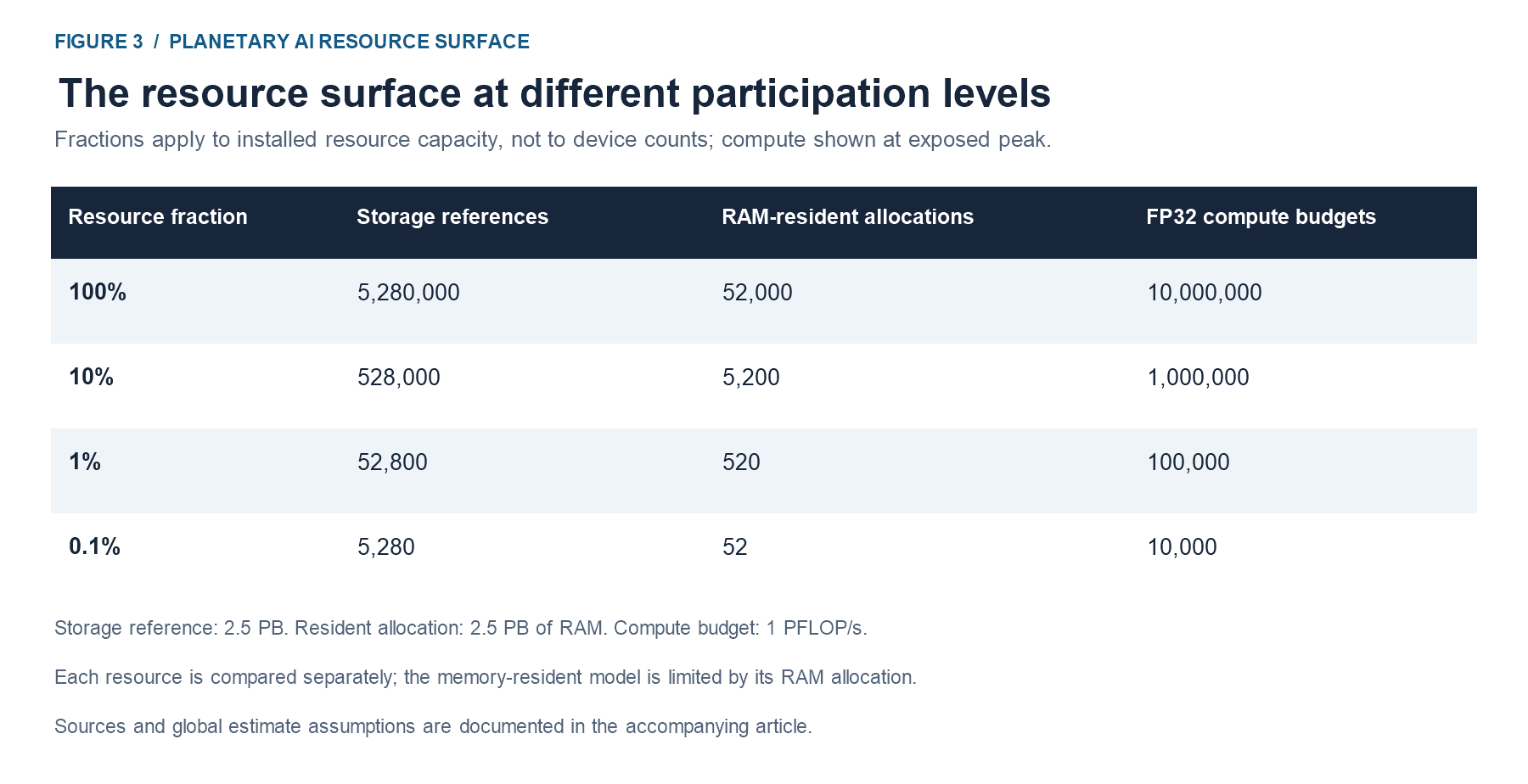
The curious observation is that substantial biological-scale resource quantities also exist throughout the digital environment. Opportunity has been accumulating through ordinary consumer purchases, enterprise infrastructure, telecommunications, and industrial deployment. A superintelligent AI could operate across a portion of that surface, using distributed resources to sustain its activity. The question is how much of this existing footprint can become accessible and useful through software, connectivity, and participation. The human brain supplies a familiar scale for seeing the magnitude of what is already available.
We do not need to maintain a scarcity mindset in the United States.
SOURCES
Global storage anchor: IDC figures reproduced in Huawei's Global Digitalization and Intelligence Index 2025.
https://www-file.huawei.com/admin/asset/v1/pro/view/5744042ca5d343df97e938f752ef82fe.pdf
Brain storage benchmark: Paul Reber, What Is the Memory Capacity of the Human Brain?, Scientific American, 2010.
https://www.scientificamerican.com/article/what-is-the-memory-capacity/
Brain computation benchmark: Joseph Carlsmith, How Much Computational Power Does It Take to Match the Human Brain?, 2020, hosted by Coefficient Giving.
Client-based participation precedent: BOINC documentation.