The 2028 Updated Horizon
The experiment in Europe, combined with accelerating political realignment in the United States, suggest that institutional transformations previously expected to unfold now occur within a single electoral cycle. The principal concern is an unmanageable loss of governing capacity, and invitation of broader global conflict across continents. Containment of external escalation is paramount while internal calibration and realignment remains underway.
Europe’s fiscal deterioration, political fragmentation, expanding collective obligations, and tensions between national sovereignty and supranational authority demonstrate how sister democracies are in retrograde. France illustrates the distinction of questionable constitutional continuity, while Britain's changing political landscape exposes the growing separation between public sentiment, parliamentary authority, and strategic alignment; the later is more informative for geopolitics.
These developments are impactful to Continental Coherence; originally developed to examine the restructuring of geopolitical authority and the institutional safeguards required to prevent major-power conflict. The framework anticipated a multidecade transition toward geographically anchored governance systems capable of managing risks associated with artificial super intelligence, autonomous military capabilities, and increasingly distributed geopolitical agency.
The original timeline has since been reassessed. Parameters have changed. Political and economic developments observed during 2025 and 2026 prove the thesis direction, but suggest a more compressed period of institutional change than initially anticipated.
The strategic concern is that the United States is on trajectory to face significant domestic institutional disruption before the international order is ready to reduce large scale kinetic conflict.
The period preceding 2028 is now framed to represent a window for course correction.
I. Europe: Institutional Retrograde as a Leading Indicator
Experiment 1: France’s repeated change in government, legislative fragmentation, fiscal disputes, and public resistance to reform demonstrate the collapse of governing utility. The French state in present condition, remains on the verge of failed functionality; durability of its governing arrangements have been repeatedly tested. The results are non-disirable.
I describe this condition as constitutional retrograde: the progressive weakening of institutional effectiveness with ambiguous change and gradual disappearance of constitutional government.
Experiment 2: Germany and other Europeans are an additional showcase. Aging populations, industrial competitiveness, energy costs, public expenditure commitments, and political fragmentation have placed substantial demands upon national institutions. These pressures are unfolding in-real-time against a model projected a single generation ahead of the current U.S. population. They demonstrate permanent failure to reform, or reverse.
These two experiments offer the United States an opportunity to examine potential consequences before comparable constraints become more deeply embedded domestically.
II. Collectivism, Fiscal Capacity, and Sovereign Responsibility
Root-cause determined: The expansion of compulsory collectivist arrangements is the central concern within this assessment. Governments assumed permanent responsibility for an increasing range of economic and social obligations and gradually reduced their capacity to respond to changing conditions. Public commitments created unpredictable expectations, while political resistance to reform made those commitments difficult to revise even when assumptions deteriorate. The nullification of Dodge is the final case and point.
The required constitutional arrangement distinguishes voluntary collectivism (contained within corporations, associations, guilds, and religions) from compulsory political collectivism. Collective responsibility must remain anchored through freely organized associations, while the government must concentrate upon responsibilities requiring sovereign authority, including national defense, public security, constitutional protection, and justice.
Empirical Challenge: Federal economic responsibility during Hoover and Roosevelt.
A sovereign government cannot indefinitely expand its responsibilities without eventually confronting limits to its fiscal, administrative, and political capacity.
III. Britain, France, and the Fragmentation of Sequence
Earlier alignment efforts between the United States, slated from 2024 forward, were expected to yield provision of a reignition and alignment. Britain demonstrated electoral realignment. Nigel Farage and Reform UK reflects substantial dissatisfaction with established political arrangements, particularly concerning national sovereignty, immigration, and the responsiveness of traditional political parties. Yet these substantial shifts in the electorate did not shift parliamentary reignition. Reignition and following versatility were a requirement for alignment efforts to remain durable; the drawback from failed parliamentary reignition is now the primary signal of what to expect in the following U.S. election cycle, and a following high probability of kinetic fallout.
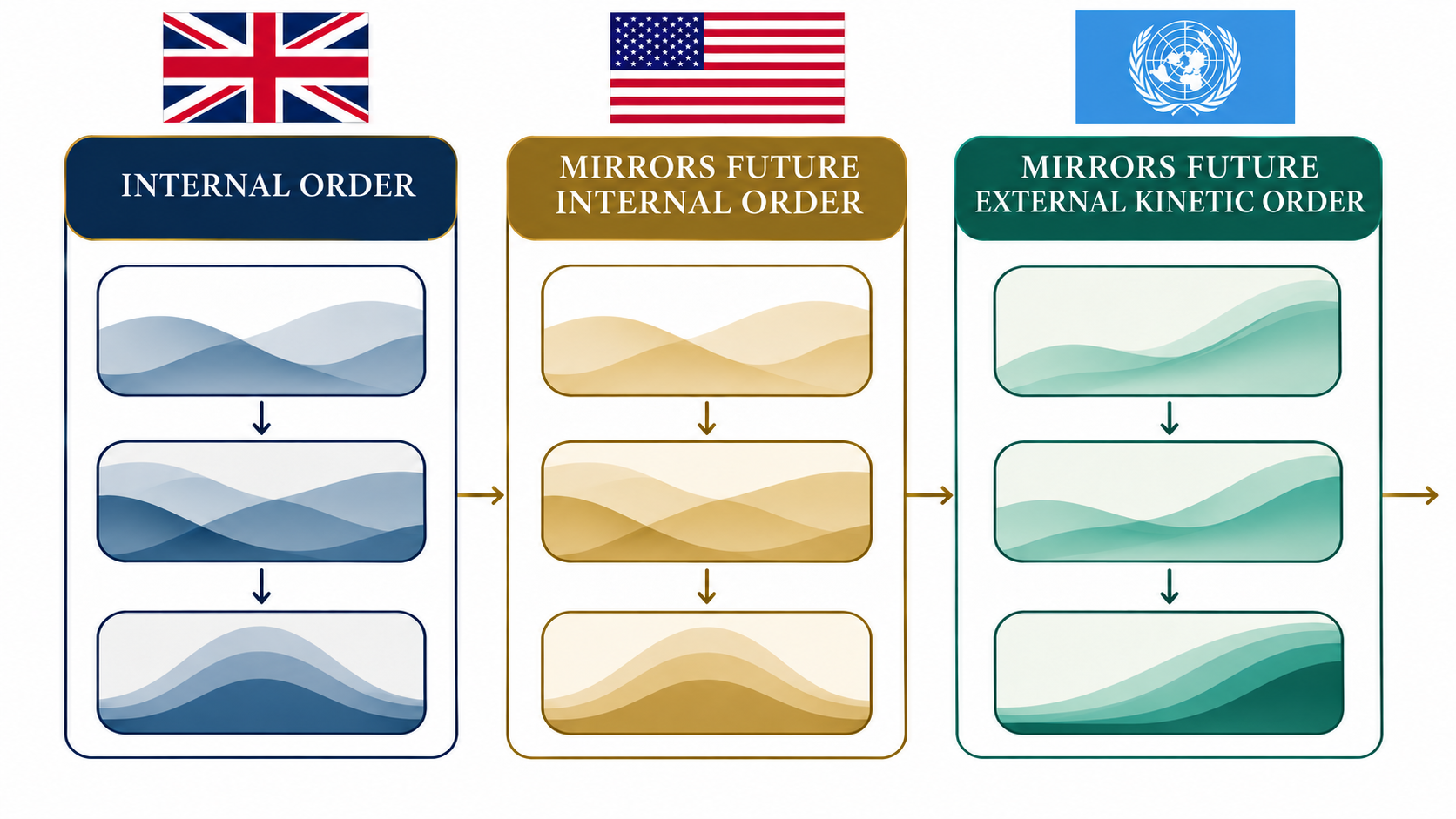
In my earlier Continental Coherence assessment, party-based alignments in Britain were modeled to foreshadow larger geopolitical provisions elsewhere on the strategic roadmap. British participation alongside the United States in the Iran conflict represented a potential counterindicator to global conflict expectations and growing geopolitical divergence. These provisions did not materialize as expected. The adjusted signal takes a weight of Britain's internal order and provides a clearer projection and accounting of what expectations should remain for internal U.S. order, and the coresponding 3rd order effect of kinetic escalation in coresponding external affairs.
IV. Central Banks and the Limits of Monetary Intervention
My original forecast identified successful central-bank stabilization as a potential counterindicator of global conflict, followed by a downshift in demand for CBDC. A durable recovery supported by sustainable public finances would have weakened the expectation of accelerating institutional retrograde.
My subsequent interpretation has been that monetary authorities have encountered increasingly visible policy constraints rather than resolving the underlying structural pressures.
September 2025: The Original Three-Option Framework
On September 12, 2025, I publicly outlined three potential responses to a severe economic and institutional crisis. The framework was explicitly conditional upon root cause.
Option 1 — Manage the Downside. Preserve existing institutions and manage the consequences of economic deterioration through conventional policy responses, accepting a period of reduced economic performance while attempting to maintain institutional continuity.
Option 2 — Domestic Rupture and Reconstruction. Dismantle and rebuild the existing system through a domestic conflict scenario, originally described explicitly in terms of civil war. This represented a hypothetical pathway of systemic reconstruction, not a demonstration that armed conflict was inevitable or capable of producing a durable constitutional settlement.
Option 3 — External Systemic Conflict. Resolve or transform the systemic failure through international remediation and delegation of force, potentially escalating into World War III and the destruction or reconstruction of major elements of the existing geopolitical order.
The original assessment identified the root cause as the determining variable. It did not establish that any option had already become necessary.
The framework was developed before the November 2026 midterms and therefore provides a dated reference against subsequent interpretations.
November 2026: Electoral and Strategic Reassessment
The November 2026 midterm elections became a significant new input into the assessment. Reported Democratic gains in Congress and 20 million blue votes in Texas, were interpreted as evidence that domestic political realignment will coincide with accelerating institutional and geopolitical pressures. This follows the projections gathered from Britain's failed re-ignition of parliament.
The central concern is interaction between a substantial shift in American political-economic priorities and concurrent structural adjustments in Europe, Russia, and China.
Within Continental Coherence, American institutional continuity serves a stabilizing function beyond domestic governance. Changes in American fiscal policy, technological development, strategic commitments, or constitutional authority (a total inversion of the previous cycle), can determine the strategic responses of other major powers and increase the odds of kinetic conflict.
The November 10 assessment revisited the September 2025 framework in light of these developments.
Option 1: is now exhausted. Incremental management is no longer considered sufficient to produce the structural correction sought within the anticipated timeframe due to new vairables in Europe.
Option 3: remains unacceptable as a global conflict will destroy the sovereign institutions, security relationships, and international arrangements that Continental Coherence was intended to preserve.
Option 2: is identified as the remaining reconstruction scenario. The initial forecast suggests a high probability of kinetic action following extreme policy shifts and compression; the current forecast retains cause, but suggests a non-kinetic possibility via Convention of States.
The U.S. midterm election did nothing to shift the Republican majority in the state electorate; Republicans hold a national majority as of 11/10/2026. Such a convention can be advocated by POTUS and appropriately timed for the new White House ballroom.
V. The Bill of Treasons: The Noval Counterweight
The idea of a Bill of Treasons is a novel concept that suggests the American constitutional framework requires clearer boundaries concerning deliberate institutional misconduct. It could be one of many potential and non-deterministic vehicles floated during such a convention.
The Bill of Rights establishes protections against governmental abuse. A proposed Bill of Treasons could complement those protections by identifying conduct that deliberately compromises the security, sovereignty, institutional integrity, and constitutional responsibilities of the republic, and exceeds the establishment of freedoms provided to all.
Provisions could address religious liberty and public funding, national security, military obligations, digital privacy, corruption within government, concealment of serious threats, judicial sovereignty, preferential criminal immunity, citizenship, and powers retained by the people.
The central objective is institutional accountability.
Public officials entrusted with constitutional responsibilities should not possess effective immunity when they deliberately fabricate evidence, obstruct lawful investigations, conceal serious wrongdoing, or sabotage national security. Similarly, institutions exercising public authority should remain subject to clear jurisdictional limits, while citizens retain protections against unlawful interference.
The proposal also seeks to strengthen digital privacy and clarify the relationship between national sovereignty and the responsibilities of citizenship.
The governing principle is strong institutional accountability.