Extraterrestrial Data - Project Tutum
Back in 2021 I sent an email to Astro teller about an idea that had been bothering me for a while. The way we think about computing for space missions is strangely outdated. Every lander that goes to the moon, or Mars, or beyond, has to carry its own computers, which means precious mass gets eaten up by hardware that is already obsolete by the time it launches. Spacecraft end up running tiny, radiation-hardened processors that are incredibly reliable, but laughably underpowered compared to what we use on Earth. The missions we send out are computationally starved. If we actually want autonomous robots, AI-assisted science, or long-term exploration, we need a better strategy. The idea came to me, after Elon Musk launched a Tesla car into space.
My idea is now called Project Tutum. Instead of every spacecraft bringing its own computing, you flip the model entirely. You send compute first in a high volume and expendable format. Then power. Then the big “mission”. Project Tutum proposes deploying small, hardened datacenter pods to Mars before any major mission arrives. Think of them as a local cloud compute backbone waiting on the surface. When future landers show up, they already have massive TPU and GPU capacity sitting there ready to help manage operations or provide inference for construction robots. Suddenly a lander doesn’t need to be a tiny self-contained brain anymore. It becomes a client connected to a local cloud.
What makes the concept fun is that it leans heavily on repurposing existing technology. My entire thesisrevolves around recycled armored vehicle hulls, specifically, the high-hardness steel monocoque from a Navistar MaxxPro MRAP. Those vehicles were designed to survive terrible explosions on Earth, which conveniently means they’re also good at surviving vibrations from rough planetary landings. Their manufacturer conveniently equipped all base models to handle extreme temperatures, shrapnel (like micro meteorites), and adverse weather conditions. There are thousands of them sitting in surplus yards, averaging $9k-$12k waiting to be repurposed for a new task.
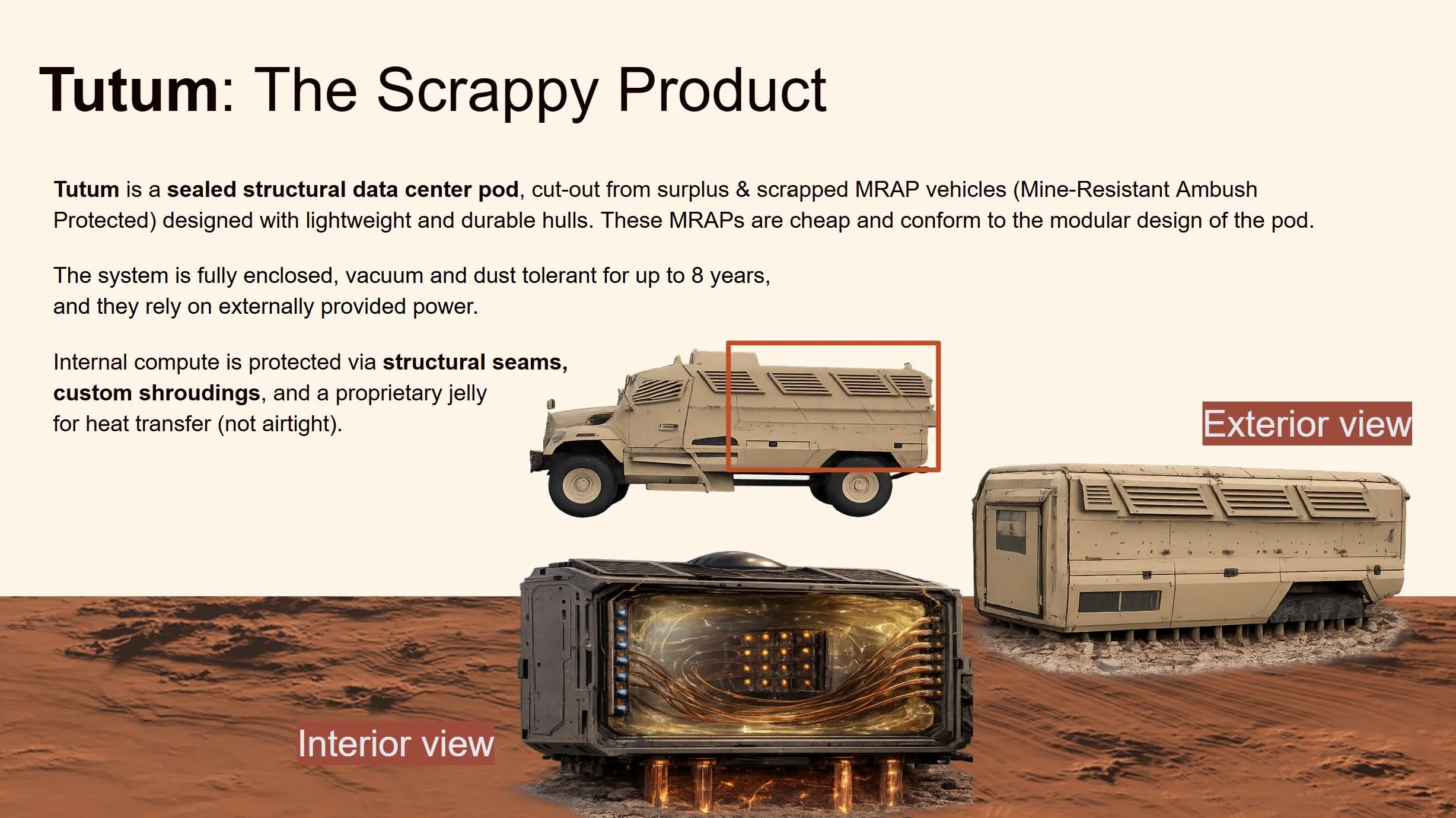
My design treats the hull like a giant server closet. All the compute hardware is mounted, then high-conductivity graphite foam fills the closet, which absorbs heat and spreads it evenly. GPU/TPU heat is transported via copper tubing and thermal couplings that poke through the hull, allowing a metal on metal connection, for heat to radiate. This design element turns the entire shell into a heat exchanger. There are no fans, pumps, or moving parts. When the pod lands, a set of small solid rocket motors reduce velocity for touchdown. The steel baseplate absorbs the impact, the graphite foam cushions the electronics, and the pod wakes up.
What makes this noval, is intentionally avoiding a lot of traditional complexity. They aren’t airtight pressure vessels, which removes a huge engineering burden and saves a massive amount of mass. The electronics are coated and surounded by graphite foam so they can operate directly in a low-pressure environment without needing atmosphere inside the pod. Power is also handled externally, usually through a small nearby nuclear reactor or long-duration energy system, so the pod itself focuses purely on compute and thermal management. And for communications, the pods can link directly to orbital satellites using high-speed laser communications.
The physics of this approach, however, brings us to a brutal bottleneck: the Delta T. In the vacuum of space or the thin soup of the Martian atmosphere, heat is a ghost you can’t easily catch. On Earth, fans move air to strip heat away, but out there, convection is dead. We are banking entirely on conduction through our copper lattice and radiation from the hull. The Delta T difference between the screaming hot H100 GPU silicon and the external radiator skin is what matters. If that gap is too wide, the heat stays trapped inside the "jelly," the chips hit 85°C, and our exascale supercomputer throttles down to the speed of a 1990s calculator. To make Tutum work, we have to prove that our jelly mixture (graphite dust, gold particles and synthetic oil) can "pump" 20kW of thermal energy through the copper lattice and out of the hull really fast.
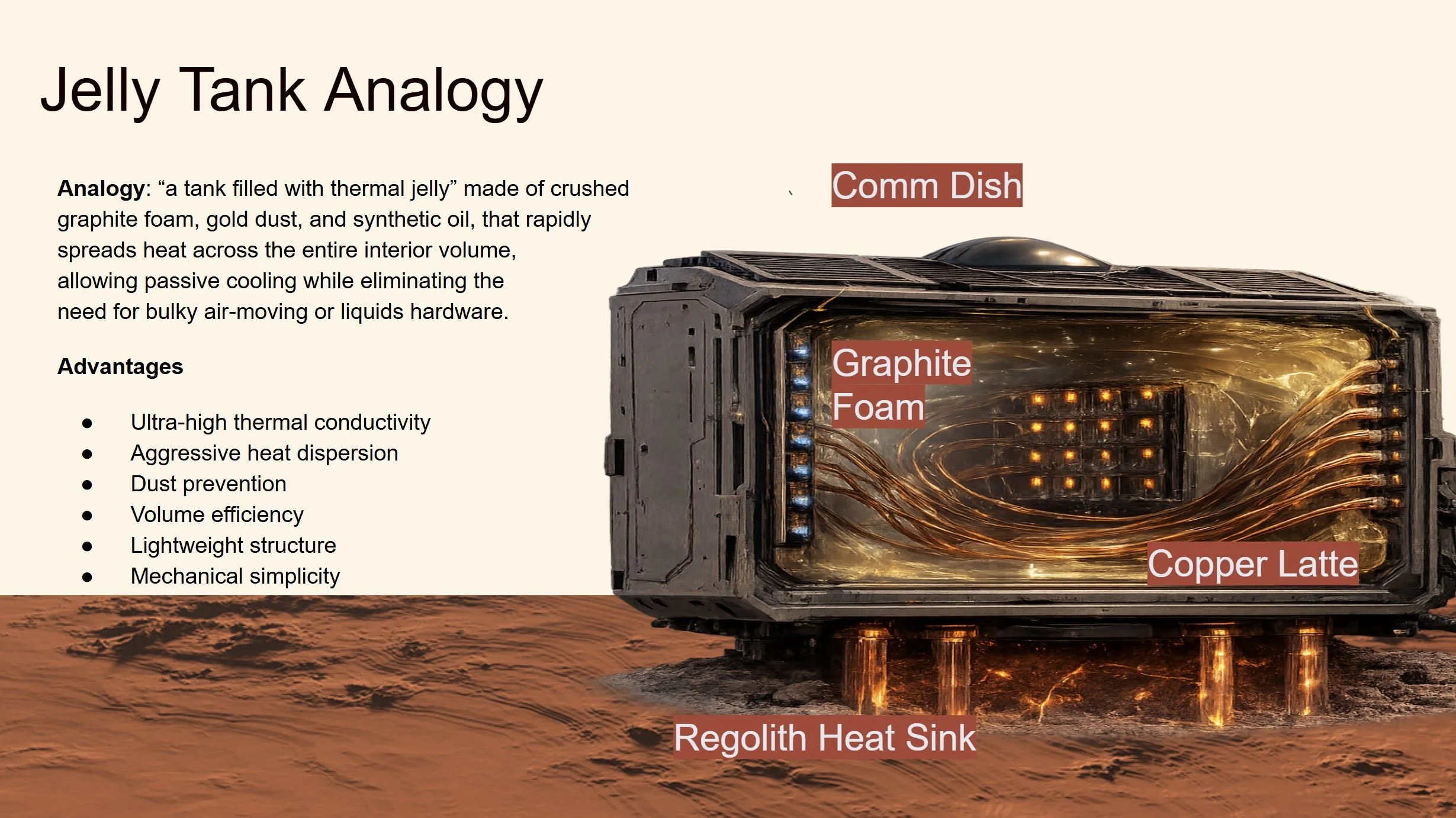
Phase 1 isn't about rocket engines; it’s about a thermal management and sensors. We need to build a full-scale thermal stack-up, instrument it with a web of thermocouples, and shove it into a vacuum to simulate the Martian void. We’ll run dummy heaters to mimic the 20kW load of 25 GPUs and map exactly how that heat crawls through the graphite foam. We’re looking for the "thermal break" spot. If we can maintain a steady state where the internal junction stays cool while the MRAP hull glows in the infrared, the design is viable. If by chance we have to worry about the jelly mixture detatching from the lattice during each heat cycle, well, we use a duel-piston (chemical) induction.
Once we know it stays cool, we have to make sure it doesn’t shatter on impact. Mars isn't a soft landing. Even with solid rocket motors and parachutes, a 4-ton steel hull hitting the surface is a violent, structural-shaming event. We need to perform "shaker" tests and high-G drop cycles to ensure the graphite foam doesn't turn into dust and the copper lattice doesn't delaminate from the compute plates. If the thermal bond breaks during landing, the pod is dead on arrival. Phase 2 is about proving that this "scrappy" assembly of recycled steel and high-tech foam can take a 20G punch to the face and wake up ready to crunch numbers. We’re building a survivor system for all of earth’s future data.
The part that really excites me is the economics. Traditional space missions treat every component like a priceless and highly fragile artifact that must never fail. Tutum flips that philosophy and treats compute pods more like flinstones infrastructure. Each pod built to withstand and costs roughly $5.2 million; delivering enormous compute density, which is worth the 4tons of weight. Launch twenty of them on a SpaceX Starship rocket and you suddenly have an exascale-class supercomputer sitting on the Martian surface for 1/3 the cost of blackhawk helicopter. Instead of betting billions on a single perfect landing, you deploy many inexpensive systems and accept that a few might not make it.
2026 Estimated Cost
Silicon & Logic - 25x NVIDIA HGX H100 SXM5 GPU ($179k ea) + 6x TPU v5p (~$40k ea value)
$4,715,000
SRM Propulsion - 6x Solid Rocket Motors/JATOs ($50k/ea) for high-G suicide burn
$300,000
Structural Hull - Surplus MaxxPro HHS monocoque purchase and structural inversion
$75,000
Thermal Matrix - ORNL-process graphite foam + precision copper thermal rivets
$100,000
Auxiliary Systems - Kevlar lid, Aures antenna, high-emissivity radiator coatings
$100,000
Cost per PetaFLOP
$49K per PetaFLOP
Cost per Pod
$5.29M
20 Pod Constellation
$105.8M
At the end of the day, Project Tutum is really about changing how we think about durability and design physics. If this seems to interest you, please contact me as I’m starting to assemble a team to flush out the first prototype. We are fucused on the thermal management hypotehsis first.